
On November 9, 2026, the Senate voted 73–25 to move the Bipartisan American Affordability and Jobs Act (BAAJA) forward despite opposition from Tribal Nations. The bill would weaken protections for sacred places and Tribal Nations’ ability to have a say in projects affecting their communities.
The fight is not over. This procedural vote moved BAAJA forward, but a Senate vote on whether to pass the bill is still ahead. Lawmakers must use this opportunity to listen to Tribal Nations and address their concerns.
On November 8, Tribal Nations and organizations issued the following statement outlining what is at stake:
WASHINGTON, D.C. – We, the undersigned Tribal Organizations, reaffirm our strong opposition to the Bipartisan American Affordability and Jobs Act (BAAJA). The manager’s amendment to BAAJA does not adequately address the serious concerns raised by Tribal Nations across the country. Despite claims that the revised legislation responds to Tribal concerns, the proposed changes to Section 106 of the National Historic Preservation Act in Title III of BAAJA continue to fundamentally undermine Tribal sovereignty, weaken longstanding federal protections, fail to ensure meaningful government-to-government Tribal consultation, and threaten sacred sites and cultural resources.
Much of the proposed language would codify elements of the Advisory Council on Historic Preservation’s (ACHP) proposed Part 800 regulations, which Tribal Nations have strongly opposed, and would further erode the Section 106 process.
Tinkering with these harmful BAAJA provisions does not resolve their fundamental flaws or the cumulative impact on Tribal cultural heritage from BAAJA and the ACHP rulemaking. Tribal sovereignty, meaningful consultation, and the protection of sacred places are not negotiable.
Congress must not advance legislation that diminishes these protections or disregards the sovereign rights of Tribal Nations. We ask Congress to hold this bill until the next Congress can engage in meaningful Tribal consultation on permitting reform. If Congress will not delay the entire bill, then, at a minimum, it must remove Title III in its entirety from the text—including all the Section 106 changes
Read the full statement here.
Tribal Nations: Your senators still need to hear from you. The Senate’s November 9 procedural vote advanced BAAJA, but it was not a vote to pass the bill. Urge your senators to oppose BAAJA as currently written and address Tribal Nations’ concerns before a final vote. Find congressional contact information below.
The Senate Bipartisan American Affordability and Jobs Act of 2026 (BAAJA) is a permitting reform bill designed to accelerate federal environmental reviews and expedite project approvals. The bill proposes significant changes to foundational environmental laws — including NEPA, the Clean Water Act, the Endangered Species Act, and the National Historic Preservation Act — as well as amendments to energy permitting, including the Federal Power Act regarding hydropower permitting. By imposing shorter review timelines and narrower definitions of what triggers a review, BAAJA reduces critical federal oversight and participation.
The bill has significant impacts on the ability of Tribal Nations to participate meaningfully in permitting issues that can effect their land, water, and cultural interests. The BAAJA severely weakens Tribal opportunities to engage as sovereign governments, curtails Tribal consultation requirements, and restricts access to legal recourse in court. A large coalition of Tribal organizations has formally opposed the entire NHPA title.
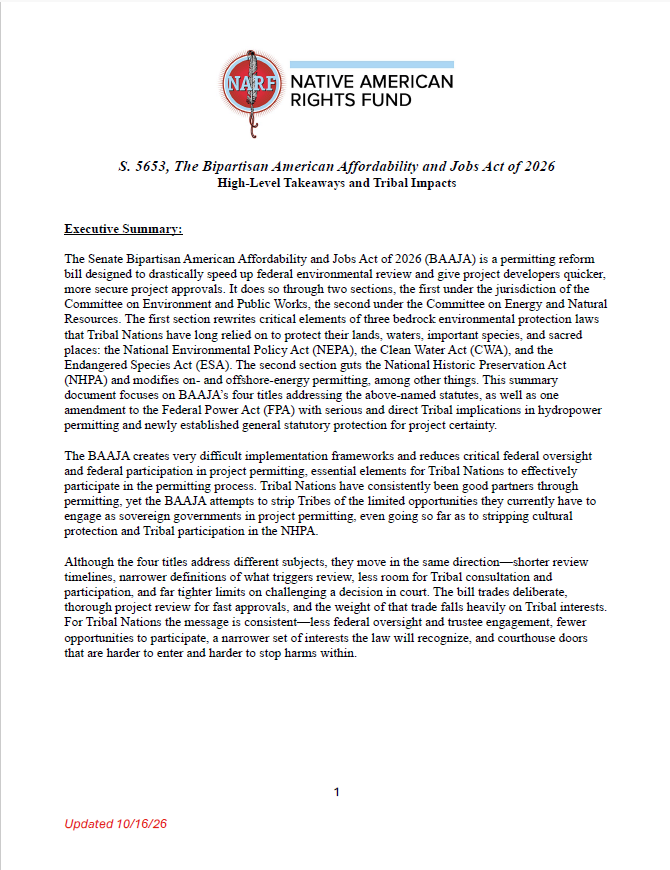
From NARF’s analysis of the bill:
The BAAJA creates very difficult implementation frameworks and reduces critical federal oversight and federal participation in project permitting, essential elements for Tribal Nations to effectively participate in the permitting process. Tribal Nations have consistently been good partners through permitting, yet the BAAJA attempts to strip Tribes of the limited opportunities they currently have to engage as sovereign governments in project permitting, even going so far as to stripping cultural protection and Tribal participation in the NHPA.
RESOURCES & ANALYSIS
JOINT LETTER FROM TRIBAL ORGANIZATIONS
In an October 9, 2026, joint letter to Senate leadership, nine Tribal organizations, including NARF, urged Congress to remove provisions of BAAJA that would weaken Tribal consultation and protections for sacred places and cultural resources. The letter calls for permitting reforms developed in collaboration with Tribal Nations that respect Tribal sovereignty, protect cultural heritage, and support infrastructure development.
READ JOINT LETTER (PDF) →MYTHS VS. FACTS
This analysis examines nine claims made by supporters of the Bipartisan American Affordability and Jobs Act (BAAJA) and compares them with the bill’s actual language. Read how the proposed changes could weaken Tribal consultation, narrow protections for sacred places, undermine Tribal Historic Preservation Offices, and limit Tribal Nations’ ability to challenge harmful projects in court..
READ MYTHS VS. FACTS (PDF) →CLEAN WATER ACT ANALYSIS
BAAJA’s proposed changes to the Clean Water Act’s Nationwide Permit program would weaken environmental protections and oversight. The bill would also expand the types and sizes of projects eligible for streamlined permitting, limit consideration of impacts on Tribal waters and resources, and make it harder to challenge potentially unlawful permits in court.
READ ANALYSIS (PDF) →Key Offices:
- Sen. Heinrich (D-NM, bill sponsor), (202) 224-5521
- Sen. Whitehouse (D-RI, bill sponsor), (202) 224-2921
- Sen. Murkowski, (R- SCIA Chair), (202) 224-6665
- Sen. Schatz (D-HI, SCIA Vice Chair), (202) 224-3934
Key Committees:
Senate Environment and Public Works Committee (originating committee)
Staff:
- Dan Dudis, dan_dudis@epw.senate.gov
- Bill Dauster, bill_dauster@epw.senate.gov
- Pierce Wiegard, pierce_wiegard@epw.senate.gov
- Adam Tomlinson, adam_tomlinson@epw.senate.gov
Senate Energy and Natural Resources Committee (originating committee)
Staff:
- Jasmine Hunt, jasmine_hunt@energy.senate.gov
- Sam Fowler, sam_fowler@energy.senate.gov;
- Maya Hermann, maya_hermann@energy.senate.gov
Senate Committee on Indian Affairs
Staff:
- Jennifer Romero, Jennifer_Romero@indian.senate.gov
- Darren Modzelewski, Darren_Modzelewski@indian.senate.gov
- Amber Ebarb, amber_ebarb@indian.senate.gov