
The Native American Rights Fund (NARF) and Dēmos announced today the conclusion of the three-year Rosebud Sioux Tribe et al. v. Barnett Settlement Agreement and Stipulated Order of Dismissal, approved by the federal district court on September 6, 2022, and expiring pursuant to its terms.
The settlement resolved litigation brought by the Rosebud Sioux Tribe, Oglala Sioux Tribe, Lakota People’s Law Project, and individual Native voters challenging South Dakota’s longstanding failures to comply with the National Voter Registration Act (NVRA). Prior to the lawsuit, driver’s license offices and public assistance agencies—particularly those serving Native communities—routinely failed to provide voter registration opportunities required by federal law.
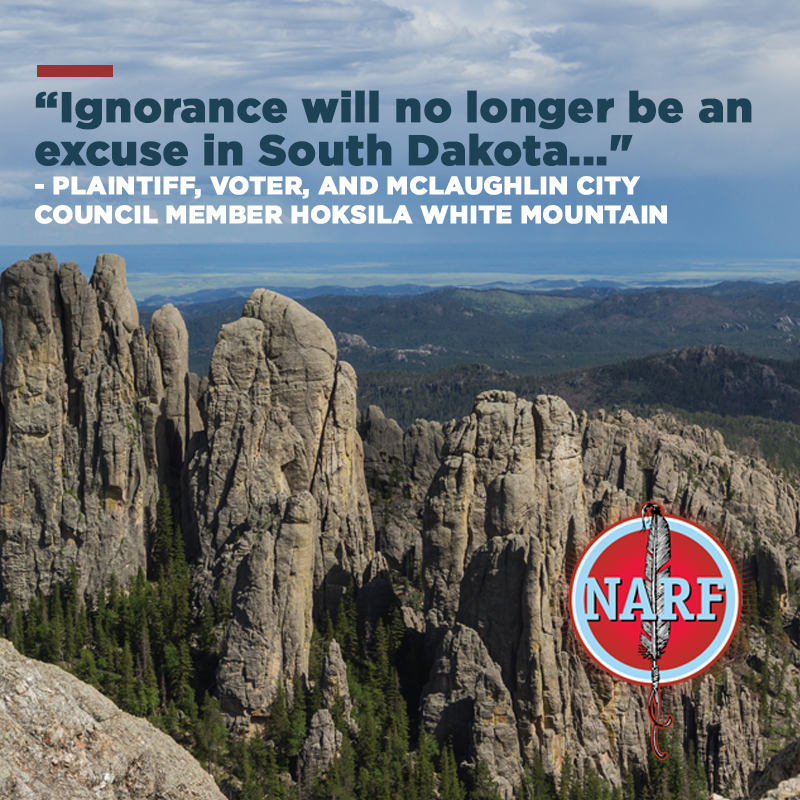
“This case forced meaningful changes that should never have required litigation in the first place,” said Rosebud Sioux Tribe President Kathleen Wooden Knife. “Native voters deserve equal access to registration every time they interact with state agencies, and we expect those obligations to continue even as this agreement ends.”
Under the agreement, South Dakota implemented significant reforms, including statewide NVRA coordination, mandatory agency training, standardized procedures for voter registration and address changes, and public reporting designed to surface compliance problems.
“As a Tribe, we brought this case to stop patterns of exclusion that were quietly but systematically disenfranchising our people,” said Oglala Sioux Tribe President Frank Star Comes Out. “The end of the settlement does not mean the end of our expectations. Compliance with Motor-Voter is the law, not a favor.”
NARF’s recent review of available data and on-the-ground information reveal ongoing systemic violations have been resolved following the litigation although some inconsistencies in application remain. NARF emphasized that NVRA violations are often revealed through lived experience rather than aggregate statistics.
“Data alone doesn’t vote — people do,” said Chase Iron Eyes, Co-Director of the Lakota People’s Law Project. “When Native voters aren’t offered registration, are misinformed, or face inaccessible offices, those harms must be taken seriously and addressed immediately.”
“The sunset of this agreement does not reduce South Dakota’s legal obligations under the NVRA,”said Samantha Blencke, Senior Staff Attorney at NARF. “It means the court’s supervision ends — not the law. We will continue monitoring compliance and rely on Tribes and voters to alert us if problems reemerge.”
“This settlement showed what sustained oversight can accomplish, but it also underscores why continued vigilance is essential,” said Neda Khoshkhoo, Interim Director, Democracy at Dēmos. “The NVRA is a core civil rights law, and states must actively ensure that voter registration is accessible to everyone, including Native voters who have too often been excluded. Ending court supervision is not an endpoint—it’s a reminder that compliance must be ongoing, transparent, and accountable.”
NARF urges Tribes and Native voters across South Dakota to continue reporting to NARF any suspected NVRA violations at Department of Public Safety driver’s license offices, Department of Social Services public assistance agencies, and Department of Labor and Regulation TANF pre-application sites. Every voter deserves to be offered the services required under law and NARF will continue to protect Native voting rights.
Additional information identifying common signs of NVRA noncompliance will be distributed directly to Tribal governments and community partners.
Learn More: Rosebud Sioux Tribe et al v. Barnett et al
More blog posts