
By: Ada Montague
April 27, 2026
Published as part of The Headwaters Report
Background and purpose of the Columbia River Treaty
Long prior to the 1961 ratification of the Columbia River Treaty (CRT), the relationship between Tribal Nations and the Columbia River was forged over thousands of years, and today harvesting fish, hunting, trapping, and gathering remain key practices.[1] Of particular importance to the lifeways of Tribal Nations in the basin are the unique anadromous fish, especially salmon. The life journey of these fish is an incredible migration from freshwater juveniles to saline ocean adults, who return to their freshwater tributaries at the end of their lifetimes to spawn and die. Some scientists describe this journey as the biological equivalent of a human being taking off their skin, turning it inside out, and putting it back on – twice.
The Columbia River system is incredibly vast, draining an area roughly the size of Texas, with 567,000 rugged and diverse square kilometers (219,000 square miles) traversing seven western states and an additional 668,000 square kilometers (257,916 square miles) in British Columbia. The volume of water that passes through the Columbia River basin is similarly massive, averaging 244 billion cubic meters (198 million acre-feet) at its mouth annually, making it second only to the Mississippi River in terms of runoff in the lower 48 States.[2]
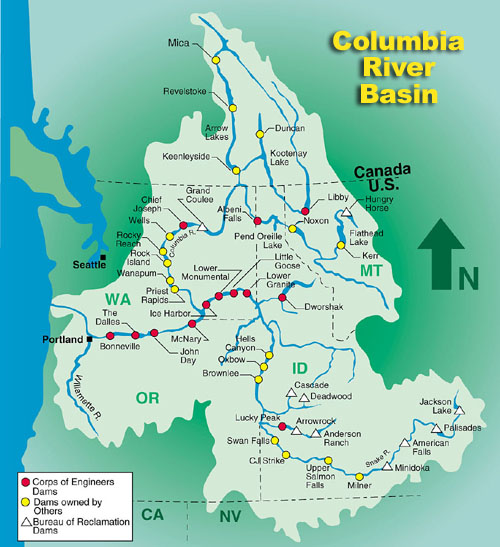
In the 19th century, Euro-American settlers brought significant changes to the basin, especially through fur trapping and dam construction. Despite initial strong resistance from Tribal Nations in the region, much of the traditional territory of the Columbia Basin was ceded to the United States government through treaties, executive orders, and other agreements, with the exception of certain lands and rights Tribal Nations reserved to themselves.[3] The result, was an altered landscape – reshaped to fit the image of new commercial enterprises such as agriculture, mining, and hydropower.
After several destructive floods in the late 1800s caused damage to homes and lives, Canada and the United States entered negotiations in the 1940s seeking to manage the flows of the Columbia River. The effort was greatly assisted by the International Joint Commission (IJC), a neutral entity created by Canada and the United States under the 1909 Boundary Waters Treaty to equitably manage the shared waterways between the two countries.[4] For twenty years, with the assistance of the IJC, Canada and the United States negotiated technical and physical methods for the management and storage of Columbia River flows and the use of resulting hydropower.[5] Tribal Nations were not parties to these negotiations, and Canada and the United States did not account for the rights of Tribal Nations nor the impacts of modified river basin governance on Tribal communities.
An agreement was reached and ratified in 1961 and today the Columbia River Treaty continues to provide flood control and coordinated upstream storage for downstream hydropower. Canada and the United States began implementing the treaty in 1964 and provided funding for the construction of three major dams in British Columbia and one in the United States. The new storage enabled through the CRT more than doubled the existing storage potential of the region. In exchange for the downstream flood protection the new dams provided, the United States agreed to pay Canada a lump sum and provide a portion of the hydropower generated by other downstream U.S. dams. This is known as the “Canadian Entitlement.”[6] The historical framework of the CRT set the stage for regional water management and power generation in the Pacific Northwest for decades to come.[7] For Tribal Nations, the impacts to fisheries were, and remain, a primary concern, as “guarantees related to tribal resources and fisheries flows … were not included in the original Treaty.”[8] Today, there is opportunity to address past wrongs through the current renegotiation of the CRT (see more in part 3 below).
The following provides an interview with Cody Desautel, the Executive Director of the Confederated Tribes of the Colville Reservation, who offers excellent context as to the history of the Columbia River Treaty and what potential exists in current renegotiation efforts to better address the issues and concerns of Tribal Nations.

Impacts on Tribal Nations and Indigenous Rights
The CRT was originally negotiated without meaningful input from Tribal Nations whose lands, rivers, and livelihoods dating back 10,000 years in some cases, were significantly and permanently affected by European settlement in the area. The construction of dams on the Columbia River inundated Tribal lands causing the loss of homes, hunting, fishing, trapping, and gathering areas, and cultural sites. The dam operations outlined in the CRT altered river flows, created reservoirs, and changed the ecosystem in ways that further disrupted traditional fishing, harvesting, navigation, and cultural practices for First Nations such as the Secwepemc (Shuswap), Syilx/Okanagan, and Ktunaxa, as well as Tribal Nations in the United States such as the Nez Perce, Colville Confederated Tribes, and many others (see footnote 1).
The CRT compounded the effects of other dams already constructed on the Columbia River. Of particular significance to Tribal Nations were the impacts to the salmon fishery at both Kettle Falls on the Upper Columbia near the Canadian border, and Celilo Falls, located about 200 miles inland from the Pacific Ocean. Both sites were significant fishing and trade locations for Tribal Nations for millennia prior to contact with European settlers. And both were permanently destroyed by the construction of downstream dams, respectively Grand Coulee on the Upper Columbia in the 1930s and the Dalles Dam on the Lower Columbia in the 1950s. The construction of the dams on the Columbia River impacted cultural sites, flooded burial grounds, and torpedoed the fisheries, including Columbia River Basin salmon and steelhead, as well as bull trout and Kootenai River white sturgeon, now all protected under the Endangered Species Act (ESA). Due to the impacts to resident fish from the construction of dams on the Columbia River, massive fish restoration efforts have been underway since 1978, when the United States first protected salmon under the ESA.[9] Renegotiating the CRT today, therefore, requires reckoning with the full history of dam construction on the Columbia River and related impacts to fisheries.
In recent years, Tribal Nations have pressed for recognition of rights, more robust consultation, and inclusion in benefit-sharing arrangements tied to CRT outcomes. The implications extend beyond economics to cultural and environmental sovereignty. For example, “Tribes and First Nations are advocating a third major criteria be included in a modernized Columbia River Treaty: ecosystem-based function—that is, taking into account fish, wildlife, habitat, water quality, and health of the river. This could be done while still meeting the needs of hydropower and flood control.”[10]
The following provides an interview with Rich Moy, a former U.S. Commissioner for the IJC and a long-time water management expert from northern Montana. His unique background and knowledge touch on the period leading up to the renegotiations of the CRT when he pushed for greater recognition and inclusion of Tribal Nations.
Contemporary Developments and Engagement with Tribal Nations
In response to concerns over lack of input from Tribal Nations in the original CRT, there have been efforts toward interim revenue-sharing arrangements, greater recognition of Tribal Nation rights, and more direct involvement of Tribal Nations in the CRT renegotiations. The focus has shifted toward reconciliation, environmental stewardship, and sustainable benefit-sharing that supports Tribal and First Nation communities’ sovereignty and self-determination.[11] On July 11, 2024, the United States and Canada jointly announced an Agreement-in-Principle (AIP) that reflects their joint understanding of a modernized CRT. While much of the actual AIP remains private due to the ongoing nature of negotiations, the countries produced a public document to describe the key elements of the AIP in 2024.[12] There are several aspects that stand out as noteworthy when considering the interests of Tribal Nations.
The terms of the original CRT did not include a termination date, although either the United States or Canada can end the treaty after 2024 with ten years prior notice. The CRT did contain a provision that terminated Canada’s obligations to operate its reservoirs for U.S. flood risk management after 60 years or by 2024. Essentially, the first 60 years of flood protection were prepaid by the United States through the Canadian Entitlement. However, thereafter, the Canadian Entitlement and flood risk management were up for renegotiation. Starting in 2018, the United States and Canada began preparing to renegotiate these portions of the CRT, this time including members of U.S. Tribal Nations and Canadian First Nations. While the AIP is not legally binding, it sets out the expectations of the two countries as they continue to work to reach a modernized treaty. Under the Trump Administration, renegotiation of the treaty has paused, and during this pause, some elements of the AIP have shaped the ongoing governance of the Columbia River, while others remain in limbo.
The public document explains that the AIP obligates Canada to continue to provide flood risk management similar to when the Treaty was first signed, but now with greater flexibility by tying flood risk management and corresponding compensation to “real-time” operations. [13] The AIP contains an “Assured Plan of Operation for 2025” (AOP25) which allows for flood flows to continue to be managed in accordance with revised management requirements but still ensures 3.6 million acre-feet (MAF) of preplanned flood risk management storage for 2025.[14] The AOP25 will remain in effect until 2027, unless and until a new Assured Plan of Operation is reached.[15] The AIP also deals with the Canadian Entitlement, which will remain in effect as negotiated in the original CRT subject to a scheduled glidepath that reduces the megawatts in hydropower generating capacity and the average megawatts of energy generated until “stabilizing in 2033-2034 at 550 megawatts of capacity and 225 megawatts of energy, and ending in 2044.”[16] In addition, the AIP outlines the downstream power benefits in a separate “Interim Period Determination of Downstream Power Benefits.”[17]
Meanwhile, the relationship between the United States and Canada has changed since the AIP was initially signed and treaty negotiations between the two countries may face increased challenges moving forward. However, the three year time limit on the AIP does not appear to pose an immediate concern. In the public document released on the AIP, the Canadian Government states that it expects the current AOP25 to automatically renew if a new agreement is not reached to take its place.[18] As such, unless the United States takes a different approach, the automatic renewal appears to offer a safety net.
While greater flexibility and more opportunity for Tribal Nations to directly impact the renegotiations of the CRT are proposed going forward, there are day-to-day effects felt now under the AIP. Negative impacts include a lower reservoir level at Grand Coulee Dam. Under the AIP, Lake Roosevelt, which is formed by Grand Coulee Dam, will be lowered an additional seven feet from March to May to provide flood storage now needed in the United States, adversely affecting ferry service across the Lake to the Colville Reservation. The lower reservoir level, “impacts emergency response and ambulance travel times, creates longer drive times for Colville government staff that live on the east side of the Columbia, and generally makes it more difficult to access the goods and services tribal members/community members need from off the reservation.”[19] The Bureau of Reclamation is evaluating whether the ferry infrastructure can be modified to operate at lower reservoir levels.[20]
More positive effects include additional flows released from Canada during May and August to support salmon and steelhead migration as well as non-ESA listed salmon reintroduction efforts above Chief Joseph and Grand Coulee dams.[21] In addition, a stakeholder group called the Kootenai/y Transboundary Collaborative Workgroup will eventually be formed if and when a new treaty is ratified by both countries to provide non-binding recommendations on system operations in coordination with an additional new advisory body called the Joint Ecosystem and Tribal and Indigenous Cultural Values Body (JEB), made up of First Nations and U.S. Tribal Nations (see second bullet for more on the JEB below).
Key Developments Concerning Tribal Nations:[22]
- Legitimacy and Participation: According to the public document describing the AIP, the modernized CRT will seek to ensure Tribal Nations are represented meaningfully in ongoing CRT renegotiations and decisions affecting river management, cultural resources, and livelihoods. The JEB is proposed to be formed as an additional management and direction body under the CRT.[23] The JEB is to be led by Tribal and First Nations and serve as an advisory body that takes input from all parties in making recommendations on decisions. As established in the AIP, “[t]he JEB will have the responsibility for developing an adaptive management (AM) program.”[24] The purpose of the AM program is to establish environmental baseline metrics and a measurement system from which to make recommendations about operational management. Meanwhile, the Permanent Engineering Board (PEB), which is made up of the entities responsible for overseeing the conduct of the CRT – namely B.C. Hydro, Bonneville Power Administration, and the U.S. Army Corps of Engineers’ Northwestern Division – will remain in charge of “assembling flow records, assisting in settling differences that may arise between the Entities, and creating annual reports of the results being achieved.”[25] Together the JEB and the PEB would collectively oversee the management of the Columbia River Basin under the new CRT. The JEB would be governed by oversight rules to be collectively developed by Canada and the United States through a joint “preparatory committee.” The preparatory committee would “establish a governance structure, terms of reference, and an initial work plan for the JEB.”[26] Some experts have advised moving away from the PEB as a controlling entity and instead consider a more interdisciplinary model to ensure greater insight informs decision making. One example of such an entity already in existence is the IJC’s binational Great Lakes Water Quality Board, which includes government representatives from both countries, the various states involved, and First Nations and Tribal Nations. Also informative from the Great Lakes is the use of a bi-national, independent water science panel that also includes representation from Tribal Nations and First Nations. This panel could oversee data monitoring, riverine science, salmon recovery, reestablishing riverine and riparian habitats, and addressing climate issues.
- One River Approach: Through the work of the JEB, the modernized CRT intends to seek to “enhance ecosystem health and integrate indigenous and Tribal cultural values in decision-making by making formal recommendations in line with its terms of reference and workplan applying a One River approach to its work. To Indigenous Nations and Tribes, the One River approach reflects the sacred duty to improve intrinsic ecosystem health for all living things from the Columbia River’s headwaters to the estuary at the Pacific Ocean. Indigenous and Tribal knowledge holders are expected to provide guidance on the One River approach.”[27] The JEB is expected to make recommendations through a workplan that provides adaptive management strategies to address anadromous fish flow augmentation and daily storage and release operations to maximize benefits in both countries while mitigating impacts to fish.[28]
- Adaptive Management, Flow Augmentation, and Salmon Reintroduction: The modernized CRT intends to implement an adaptive management program through the JEB that will establish environmental baseline goals, a long-term monitoring regime, and the benchmarks that will trigger operational adjustments in both countries.[29] In addition, there will also be anadromous fish flow augmentation to provide certainty in spring and summer flow for migrating fish, as well as salmon reintroduction to blocked areas of the Columbia Basin. Reintroduction efforts will consider “available habitat, operational considerations (such as flow volume and timing), and passage/transport through dams and reservoirs upstream of and including Chief Joseph and Grand Coulee dams.”[30]
Conclusion
The CRT is a historic, international treaty that set in motion a dual-sovereign management regime of the Columbia River Basin for the last sixty plus years. It created certainty for hydropower and flood protection, but negatively affected fish and wildlife habitat as well as the sovereign rights, cultural and sacred places, and lifeway norms for Tribal Nations and First Nations on both sides of the border. Today, the renegotiation of a modernized CRT, with input from Tribal Nations and First Nations, is providing a much-needed holistic perspective on the function, purpose, health, and long-term sustainability of the river to meet all the competing demands on its flows. In the process, the negotiating parties are thus far charting a new path to resiliency, demonstrating in the terms and management structure of the modernized CRT how multiple sovereign interests can intersect and cooperate to achieve common goals through collaborative governance structures.
[1] Today, the federally recognized Tribal Nations that continue to call the Columbia River System home in the United States are as follows: in Washington – The Confederated Tribes of the Colville Reservation, The Kalispel Indian Community of the Kalispel Reservation, The Spokane Tribe of the Spokane Reservation, and The Confederated Tribes and Bands of the Yakama Nation; in Idaho – The Kootenai Tribe of Idaho, The Coeur d’Alene Tribe, The Nez Perce Tribe, The Shoshone-Bannock Tribe of the Fort Hall Reservation, and The Shoshone-Paiute Tribe of the Duck Valley Reservation, Nevada; in Montana – the Confederated Salish and Kootenai Tribes of the Flathead Reservation; in Oregon – The Confederated Tribes of the Umatilla Indian Reservation, The Confederated Tribes of the Warm Springs Reservation of Oregon, The Confederated Tribes of Grand Ronde Community of Oregon, and The Burns Paiute Tribe. In Canada, several First Nations also have a long-standing relationship with the Columbia River System, including The Okanagan Nation Alliance, The Ktunaxa Nation, and The Sinxt Confederacy. See list from Northwest Power and Conservation Council Report at https://www.nwcouncil.org/reports/columbia-river-history/indiantribes/.
[2] Bonneville Power Administration, U.S. Bureau of Reclamation, U.S. Army Corps of Engineers, The Columbia River System Inside Story, 2d Ed. (April 2001) https://www.bpa.gov/-/media/Aep/power/hydropower-data-studies/columbia_river_inside_story.pdf (“The Columbia River has an average annual runoff at its mouth of about 244 billion cubic meters (198 million acre-feet) (average year-round flows of 7,787 m3/s (275,000 cfs)), making it second only to the Missouri-Mississippi River system in the United States in runoff.”).
[3] Dupris, C. Joseph, et al. The Si’lailo Way: Indians, Salmon and Law on the Columbia River 25 (2006).
[4] British Columbia, History: Columbia River Treaty, https://engage.gov.bc.ca/columbiarivertreaty/history/ (last visited 2/24/2026) (“The IJC established the International Columbia River Engineering Board whose mandate was to support the investigation and conduct technical studies.”).
[5] Snoflo, Columbia River River Levels, (March 30, 2026) https://snoflo.org/river-levels/columbia-river (The Columbia River highest peak flow was recorded at 1,735,000 cubic feet per second.).
[6] Stern, Charles V., Congressional Research Service, The Columbia River Treaty, Summary (Dec. 3, 2024) https://www.congress.gov/crs-product/R43287 (“Some have estimated the Canadian Entitlement to be worth as much as $335 million annually.”) (hereafter “Stern CRS Report”).
[7] Id.
[8] Id. at 1.
[9] Northwest Power and Conservation Council, Endangered Species Act, Columbia River salmon and steelhead, and the Biological Opinion, https://www.nwcouncil.org/reports/columbia-river-history/endangeredspeciesact/ (last visited March 2, 2026).
[10] Energy Regulation Quarterly, The modernization of the Columbia River Treaty: Interim arrangements to implement the Agreement-in-Principle (July 2025), https://energyregulationquarterly.ca/articles/the-modernization-of-the-columbia-river-treaty-interim-arrangements-to-implement-the-agreement-in-principle#sthash.PedM8bOz.dpbs (last accessed March 2, 2026); see also British Columbia, News Release, Agreements address Columbia River Treaty impacts on Indigenous Nations, https://archive.news.gov.bc.ca/releases/news_releases_2020-2024/2023IRR0035-000895.pdf (last visited March 2, 2026).
[11] Bankes, Nigel, University of Calgary Faculty Law Blog, ABLawg.ca, New “Public Document” on the Agreement in Principle to Modernize the Columbia River Treaty, (Sept. 2024), https://ablawg.ca/wp-content/uploads/2024/09/Blog_NB_CRT_AiP.pdf (hereafter “Bankes Law Blog”).
[12] British Columbia, Negotiations to Modernize the Columbia River Treaty Agreement-in-Principle Content Public Document, (Aug. 2024), https://engage.gov.bc.ca/app/uploads/sites/6/2024/09/CRT-AIP-Canada-public-description-Final_2024Aug30.pdf; see also British Columbia, Columbia River Treaty: An Agreement-in-Principle has been reached to modernize the Treaty, https://engage.gov.bc.ca/columbiarivertreaty/agreement-in-principle/ (last visited March 30, 2026).
[13] U.S. Army Corps of Engineers, Columbia River Basin Water Management, https://www.nwd.usace.army.mil/crwm/columbia-river-treaty/#:~:text=In%202024%2C%20the%2060%20years,%E2%80%9Creal%2Dtime%E2%80%9D%20operations (last visited March 30, 2026).
[14] U.S. Dept. of State, Details About the Key Elements Agreed Between the United States and Canada Regarding Modernization of the Columbia River Treaty Regime, (July 26, 2024) https://www.state.gov/bureau-of-western-hemisphere-affairs/details-about-the-key-elements-agreed-between-the-united-states-and-canada-regarding-modernization-of-the-columbia-river-treaty-regime (hereafter “U.S. Summary of AIP”).
[15] Canadian Department of Foreign Affairs, Trade and Development, AOP25, (Sept. 18, 2024), https://engage.gov.bc.ca/app/uploads/sites/6/2024/12/20240920_AOP25_DDPB_EON_Executed.pdf.
[16] British Columbia, Columbia River Treaty: Interim Period Entity Agreements, https://engage.gov.bc.ca/columbiarivertreaty/interim-period-entity-agreements/ (last visited March 30, 2026) (hereafter “B.C. Interim Agreements”); U.S. Summary of AIP, supra note 14.
[17] B.C. Interim Agreements, supra note 16.
[18] Id.
[19] Lake Roosevelt Forum, Columbia River Treaty Interim Measures Adopted, (Jan. 29, 2025) https://lrf.org/news/columbia-river-treaty-interim-measures-adopted/
[20] Id.
[21] Id.
[22] Upper Columbia United Tribes (UCUT), Columbia River Treaty, https://ucut.org/project/columbia-river-treaty/ (last visited March 3, 2026); see also Columbia River Basin Tribes, Common Views on the Future of the Columbia River Treaty (Feb. 25, 2010), https://critfc.org/wp-content/uploads/2015/05/Common-Views-statement.pdf?x78172; see also United Nations, U.N. Declaration on the Rights of Indigenous Peoples, Arts. 18–19.
[23] Bankes Law Blog, supra note 11.
[24] Id. (“For an early reference to AM in the Columbia Basin see Kai Lee, Compass and Gyroscope: Integrating Science and Politics for the Environment (Washington, DC: Island Press, 1993).”).
[25] U.S. Army Corps of Engineers, Permanent Engineering Board, https://www.nwd.usace.army.mil/crwm/peb/ (last visited March 3, 2026).
[26] Bankes Law Blog, supra note 11.
[27] British Columbia, Negotiations to Modernize the Columbia River Treaty Agreement-in-Principle Content Public Document, 6-8 (Aug. 20, 2024) https://engage.gov.bc.ca/app/uploads/sites/6/2024/09/CRT-AIP-Canada-public-description-Final_2024Aug30.pdf.
[28] Id.
[29] Id.
[30] Id.
More blog posts