
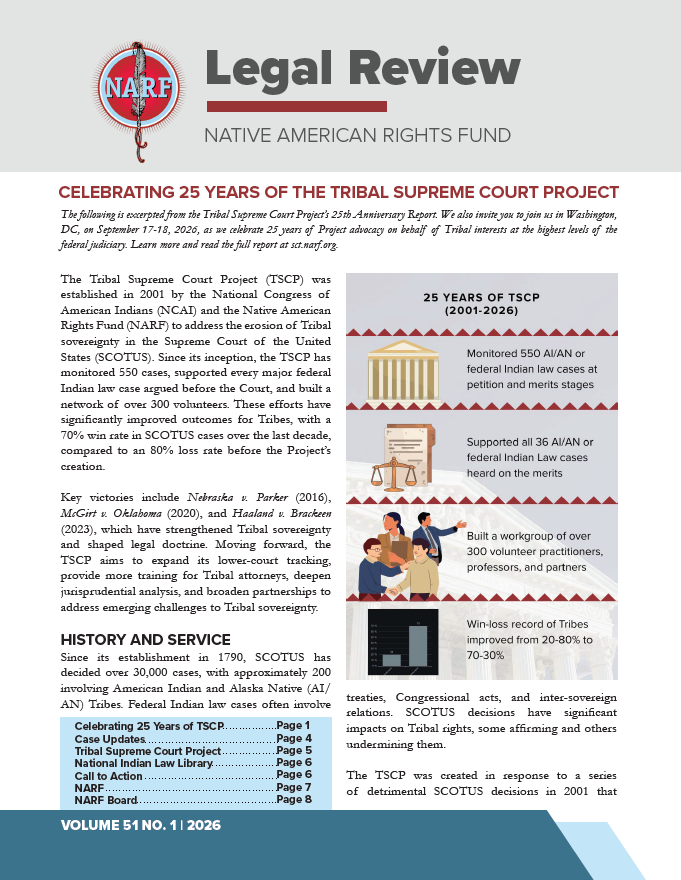
The NARF Legal Review is published semi-annually and provides updates on NARF’s work and other timely Indian law topics. The most recent edition examines some of NARF’s work from the Fall of 2025 through Spring of 2026, including:
Celebrating 25 Years of the Tribal Supreme Court Project — The Tribal Supreme Court Project (TSCP) was established in 2001 by the National Congress of American Indians (NCAI) and NARF to address the erosion of Tribal sovereignty in the Supreme Court of the United States (SCOTUS). Since its inception, the TSCP has monitored 550 cases, supported every major federal Indian law case argued before the Court, and built a network of over 300 volunteers. These efforts have significantly improved outcomes for Tribes, with a
70% win rate in SCOTUS cases over the last decade, compared to an 80% loss rate before the Project’s creation.
Case Updates — We have developed a comprehensive set of “Know Your Rights” resources to support Native Americans who may encounter U.S. Immigration and Customs Enforcement (ICE) and address reports of unlawful targeting and detention of Tribal citizens. These materials emphasize that Native Americans are U.S. citizens and that ICE generally lacks jurisdiction over them in immigration matters, while recognizing that enforcement actions have nonetheless impacted Native communities.
Additionally, NARF is supporting Tribal Nations in ongoing litigation before the Michigan Supreme Court challenging the approval of Enbridge’s proposed Line 5 oil tunnel beneath the Straits of Mackinac. The latest development occurred on March 11, 2026, when the court heard oral arguments in consolidated cases brought by Tribal Nations and environmental organizations seeking review of the Michigan Public Service Commission’s 2023 permit approval.
National Indian Law Library — Every Wednesday, the Indian Law Bulletins provide subscribers with a free round-up of court opinions, legislation, regulatory updates, law review articles,
and news relevant to legal issues in Indian Country. Library staff research updates in these many areas, tracking down items from a wide variety of sources.
You can learn more about NARF’s work, current and past, in the Legal Review archive.
More blog posts