
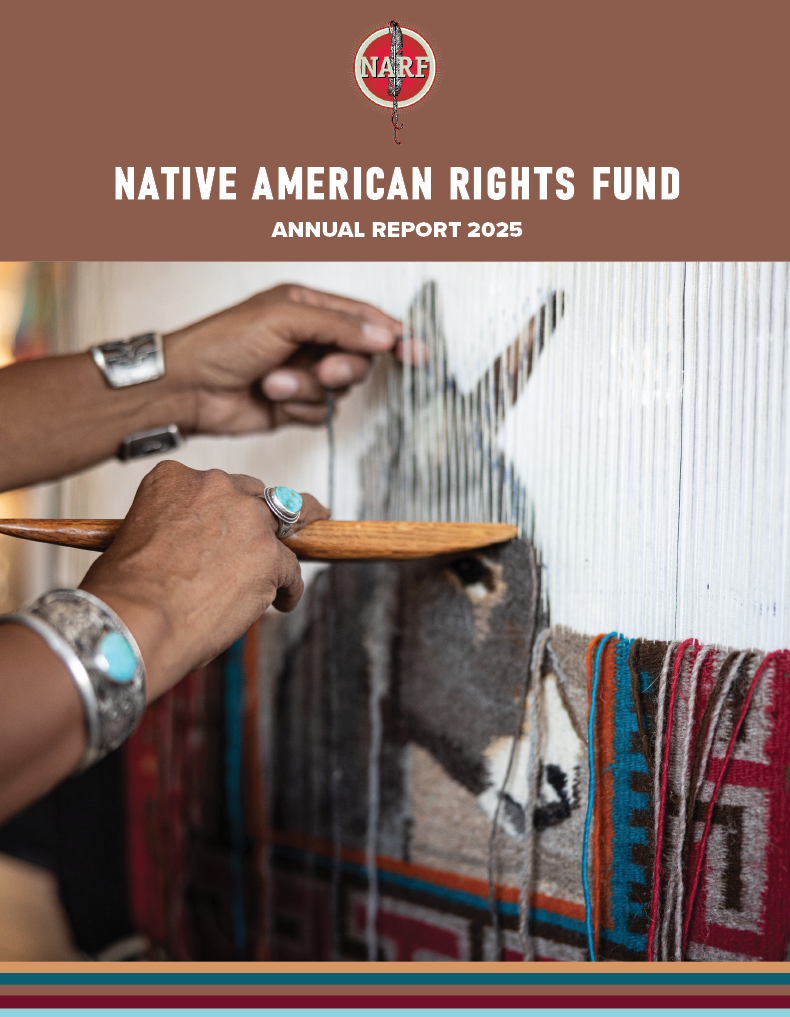
The NARF 2025 Annual Report is now available!
The annual report is an opportunity to see how your donations are paying off as an investment in justice. The report covers projects and case development from the past year and is organized by NARF’s five guiding principles:
1. Preserve tribal existence
2. Protect tribal natural resources
3. Promote Native American human rights
4. Hold governments accountable to Native Americans
5. Develop Indian law and educate the public about Indian rights, laws, and issues
In addition to NARF’s work, this year’s report features an inside look on Roy Kady, a Diné Master Textile Weaver and fiber artist. We hope you can take a moment and check out the report!
From the Report: Executive Director’s Report
2025 was the 55th year that the Native American Rights Fund has served as the national Indian legal defense fund providing legal advice and assistance to Tribes, Native organizations, and individuals in cases of major significance across the country.Once again, we were proud to be able to help our Native American clients achieve several significant legal victories and accomplishments during the year.
Maverick Gaming LLC challenged the constitutionality of the Indian Gaming Regulatory Act and Tribal compacts in Washington state. Shoalwater Bay Indian Tribe moved to dismiss the case for failure to join Tribes in the suit who are immune from suit without their consent. The district court granted the motion and the Ninth Circuit affirmed. Along with private counsel, NARF represented Shoalwater Bay and the Supreme Court declined to hear the case.
The State of Alaska filed a complaint in 2020 challenging three decisions made by the Federal Subsistence Board related to subsistence hunting in rural Alaska. The State alleged that the Board acted outside its authority. NARF intervened on behalf of the Organized Village of Kake to defend the Board’s authority to authorize emergency hunts. The district court upheld the Board’s authority, and the State appealed. The Ninth Circuit held that the case met a mootness exception and should be reheard by the district court. On remand, the district court upheld the Board’s authority on all counts. The State again appealed, and the Ninth Circuit upheld the Board’s authority, providing a complete victory for the Board and the Organized Village of Kake.
In 2021, in response to the crash of the salmon fishery, the U.S. closed the Kuskokwim River fishery but allowed limited openings for Alaska Natives with subsistence priority. The State of Alaska claimed to open the river to all Alaskans, and was sued by the U.S. On behalf of the Association of Village Council Presidents and two subsistence users, NARF intervened in the case on the side of the U.S. The district court ruled in favor of the U.S. and NARF’s clients, rejecting Alaska’s attack on federally protected subsistence rights. The Ninth Circuit affirmed. Alaska petitioned the U.S. Supreme Court for review, but the petition was denied in early 2026.
Mauna Kea, the tallest mountain on the Hawaiian Islands, has long been regarded as one of the most sacred places in Hawaii. It has become a focal point for American astronomy, and astronomers have sought to construct a new telescope on Mauna Kea. That has been fiercely opposed by Native Hawaiians, and NARF partnered with the Native Hawaiian Legal Corporation in representing them in the review processes. Subsequently, the National Science Foundation stated it would not fund the new telescope.
In early 2025, President Trump initiated large-scale reductions in federal staffing, including schools operated by the Bureau of Indian Education across the nation. NARF brought suit challenging the staff reductions on behalf of the Pueblo of Isleta, Prairie Band of Potawatomi Nation, and the Cheyenne Arapahoe Tribes. The failure to consult with Tribes was unlawful, and as a result the Bureau of a Indian Education re-hired all personnel.
In 2020, NARF filed suit on behalf of the Rosebud Sioux and Oglala Sioux in South Dakota alleging violations of the National Voter Registration Act. After winning a motion to dismiss and partial summary judgment, the Tribal Nations negotiated a comprehensive settlement agreement which finished in late 2025. NARF concluded additional court enforcement is not warranted at this time.
In Walen v. Burgum, two individuals brought suit in 2022 in North Dakota seeking to eliminate the majority-Native state legislative subdistrict encompassing the Fort Berthold reservation. The Tribal Nation and Native voters intervened to defend the subdistrict, and a Native was elected there for the first time in a long time. In 2023 a three-judge panel dismissed the case, ruling in the Tribe’s favor, and so did the U.S. Supreme Court in 2025. NARF co-counseled in the case with private counsel.
The Toronto O’odham Nation, the Gila River Indian Community, and future Native voters filed a lawsuit challenging an Arizona law requiring individuals to provide documentary proof of residence to vote. The law was passed despite the known lack of addresses on homes on Tribal lands in Arizona. In 2024, the district court ruled the proof of address requirement is preempted under the National Voter Registration Act and that no one is required to have a street address to register in any election. The Ninth Circuit upheld that win in 2025.
The Chippewa Cree Tribe of the Rocky Boy’s Reservation and two Native voters residing in Chouteau County, Montana, challenged the at-large system used to elect the county board of commissioners because it unlawfully dilutes the voting strength of Native Americans. In 2025, the parties reached a settlement that will end the at-large election system and establish a single-member district designed to provide Native voters with a meaningful opportunity to elect a candidate of their choice.
Toyukak v. Treadwell is litigation brought by Alaska Native Villages and Alaska Native voters in 2013 to enforce the statutory guarantee of language assistance under section 203 of the Voting Rights Act and the voting guarantees of the Fourteenth and Fifteenth Amendments of the Constitution. In 2014 the district court held that Alaska violated the VRA and in 2015 approved a settlement agreement that provided broad relief in the form of a comprehensive language assistance program. In 2025, the parties extended the settlement agreement to 2026.
These legal victories and accomplishments would not have been possible without the contributions and grants from the many supporters of our nonprofit organization. We thank you for your support and hope that your support will continue in 2026 and beyond so we can continue to pursue justice for Native Americans.
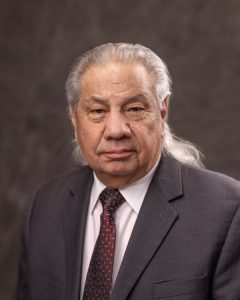
John E. Echohawk
Executive Director