
Background
For decades, NARF represented Katie John, an Ahtna Athabaskan Indian and the daughter of the last chief of Batzulnetas. Katie John fought to sustain her way of life by protecting her right to subsistence fishing — the practice of harvesting fish for one’s family and community. Throughout decades of litigation that have become called the Katie John cases, the State of Alaska fought a federal law establishing a priority for rural subsistence fishing meant to protect the way of life for many Alaska Natives. Now, in what feels like the worst form of déjà vu, the state is fighting to overturn the precedents set by the Katie John cases. The United States Supreme Court announced on January 12, 2026, that it will not review the State of Alaska’s latest challenge to long-standing federal protections for rural subsistence rights. This decision officially ends U.S. v. Alaska, reaffirming the legacy of the landmark Katie John cases and ensuring that Alaska Native peoples can continue to practice their traditional hunting and fishing lifeways. Read more about Alaska Native subsistence rights in Tribes’ never-ending battle to protect subsistence fishing in Alaska, published in the Headwaters Report in November 2025.
Litigation
Western Alaska, including the Kuskokwim River, is experiencing a severe, multi-year, multi-species salmon crash. This crisis has been devastating for communities in the region who rely on salmon for nutritional, spiritual, and cultural wellbeing.
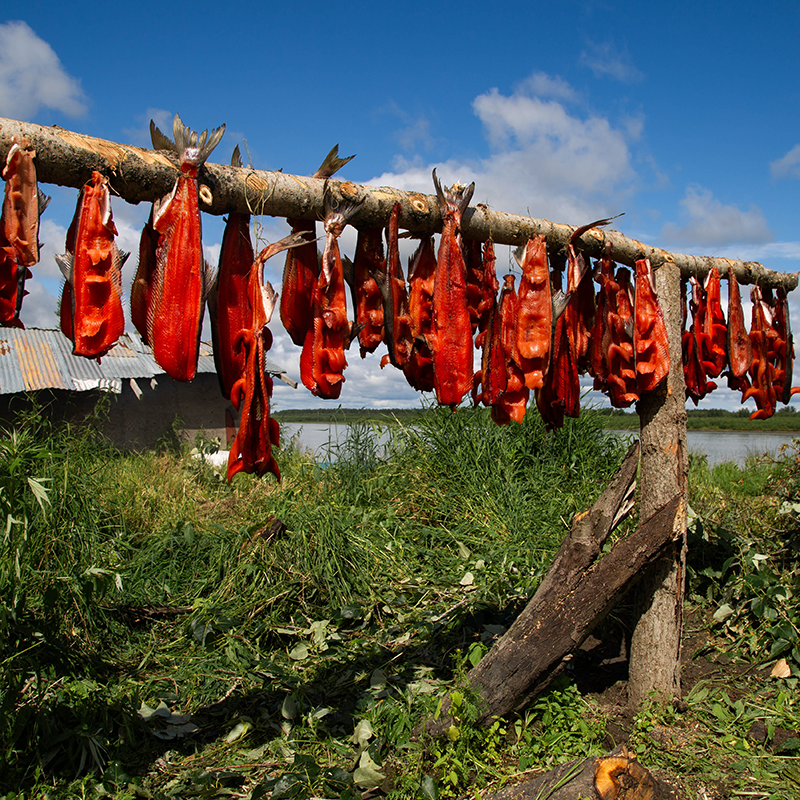
In 2021, the United States closed the Kuskokwim River fishery within the Yukon Delta National Wildlife Refuge in response to the ongoing salmon crash, but allowed limited openings only for local, federally qualified users to fish for salmon. This action was taken in an effort to conserve the salmon population for continued subsistence uses, and it fulfilled the federal government’s responsibility to provide a preference for rural subsistence users under the Alaska National Interest Lands Conservation Act (ANILCA). However, at the same time, the State of Alaska issued orders that purported to open the same stretch of the Kuskokwim River to fishing by all Alaskans, not just rural Alaska subsistence users. This caused confusion among residents of the region and interfered with the United States’ attempts to provide the subsistence priority that is essential to Alaska Native physical, economic, traditional, and cultural existence. The very same pattern was cued up to repeat for the following salmon season: the United States planned to provide limited openings only for federally qualified subsistence users but the State of Alaska intended to open its fisheries to all Alaskans during the same times.
In response to the state’s proposed actions, the United States sued the State of Alaska for interfering with federal implementation of ANILCA’s rural subsistence priority along the Kuskokwim River. On behalf of our clients, the Association of Village Council Presidents and two federally qualified subsistence users, Betty Magnuson and Ivan Ivan, NARF filed a motion and successfully intervened in the case on the side of the United States. Other parties with subsistence interests, including the Kuskokwim River Inter-Tribal Fish Commission, who co-manages Kuskokwim River salmon populations with the United States, have also successfully intervened.
After oral arguments in June 2022, the Federal District Court for the District of Alaska issued a preliminary injunction preventing the state from authorizing fishing on the Kuskokwim River within the Refuge. The court concluded that federally qualified subsistence users along the Kuskokwim River would be “irreparably harmed” if the state’s planned openers were allowed to take place. This important injunction prevented the State of Alaska from unlawfully interfering with its implementation of ANILCA’s subsistence priority during the 2022 fishing season.
The federal government and the Tribal intervenors filed motions for summary judgment in July 2023. The State of Alaska filed its own cross motion for summary judgment, expanding the scope of the litigation to argue that the Federal Subsistence Board’s entire authority to manage subsistence fishing in the Kuskokwim River was void because the river is not “public land” under ANILCA. These arguments cut right to the heart of the Katie John line of cases, which are the foundation of all federal subsistence fishing management in Alaska.
On March 29, 2024, the court ruled in favor of the United States and NARF clients Association of Village Council Presidents, Betty Magnuson, and Ivan Ivan, rejecting the State of Alaska’s attack on federally protected subsistence rights and permanently enjoining the State of Alaska from repeating its unlawful actions on the Kuskokwim River. The state appealed to the U.S. Court of Appeals for the Ninth Circuit.
August 2025: Association of Village Council Presidents and Allies Win Federal Court Case Which Protects Subsistence Fishing Rights, Defends Katie John Cases
A news release from our client the Association of Village Council Presidents:
On August 20, 2025, the Ninth Circuit Court of Appeals ruled in favor of the United States, the Association of Village Council Presidents (AVCP), and our allies, rejecting the State of Alaska’s attack on federally protected subsistence rights and the Katie John line of cases. The Ninth Circuit affirmed the March 2024 decision from the federal District Court for the District of Alaska and the permanent injunction that precludes the State of Alaska from taking actions that interfere with federal efforts to implement a rural subsistence priority established by the Alaska National Interest Lands Conservation Act (ANILCA).
ANILCA recognizes that subsistence fishing is essential to Alaska Natives’ physical, economic, traditional, and cultural existence, and mandates a subsistence fishing priority for rural residents whenever it becomes necessary to restrict fishing to conserve fish populations. Due to the State’s decades-long refusal to comply with ANILCA, the United States regulates fishing on public lands in Alaska, including on the portion of the Kuskokwim River that lies within the Yukon Delta National Wildlife Refuge (Refuge).
Western Alaska, including the Kuskokwim River, is experiencing a severe, multi-year, multispecies salmon crash that is devastating for our families and communities. In response to this crisis, the United States has been forced to restrict fishing and implement ANILCA’s rural subsistence priority in the Refuge. Yet in 2021 and 2022, the State repeatedly interfered with the implementation of the rural subsistence priority when the Alaska Department of Fish & Game attempted to open the river to fishing via emergency orders that blatantly contradicted federal orders. And in 2023, to defend its unlawful actions in court, the State expanded its attack on federally protected subsistence rights by directly challenging ANILCA and the Katie John line of cases.
Vivian Korthuis, CEO of AVCP applauded the Ninth Circuit’s decision: “This case was another blatant attack on the subsistence rights of Alaska Native people. The Ninth Circuit plainly and clearly rejected the State’s arguments. AVCP is committed to defending our traditional waters, our communities, and our ways of life. We are resilient and will continue to fight for our families and communities. And we are proud to stand with the Kuskokwim River Inter-Tribal Fish Commission, the Alaska Federation of Natives (AFN), Ahtna Tene Nené, and Ahtna, Inc., and all of our allies who have supported this effort.” Korthuis continued: “Although Katie John is not with us to celebrate this victory, as the Ninth Circuit said yesterday, ‘the precedent that bears her name lives on.” We honor her memory in this victory.
On September 15, 2025, the State of Alaska petitioned the United States Supreme Court to review the case.
The United States Supreme Court announced on January 12, 2026, that it will not review the State of Alaska’s latest challenge to long-standing federal protections for rural subsistence rights. This decision officially ends U.S. v. Alaska, reaffirming the legacy of the landmark Katie John cases and ensuring that Alaska Native peoples can continue to practice their traditional hunting and fishing lifeways.
The Supreme Court’s refusal to hear the case means that the lower court ruling stands, preserving federal authority over subsistence management on federal public lands and waters. This outcome marks the end of a costly and prolonged effort by the State of Alaska to undermine rural subsistence protections—efforts that have spanned generations and consumed millions of dollars.
“NARF filed Katie John’s first case in December 1985 and for forty years has worked to protect the subsistence rights that sustain Alaska Native communities and cultures,” said NARF Senior Staff Attorney Erin Dougherty Lynch. “Today’s decision closes the door on decades of litigation aimed at eroding those rights.”
While this is a moment of celebration, NARF remains vigilant. Outside interests and state agencies continue to push for changes that would weaken existing federal subsistence regulations. NARF joins our client the Association of Village Council Presidents in calling on the State of Alaska to abandon these attacks and work collaboratively to uphold the rights guaranteed under federal law.
NARF will continue to defend subsistence rights in every venue where they are challenged. Today, we honor our clients’ determination, Katie John’s enduring legacy, and the strength of Alaska Native communities who have never wavered
More Cases