
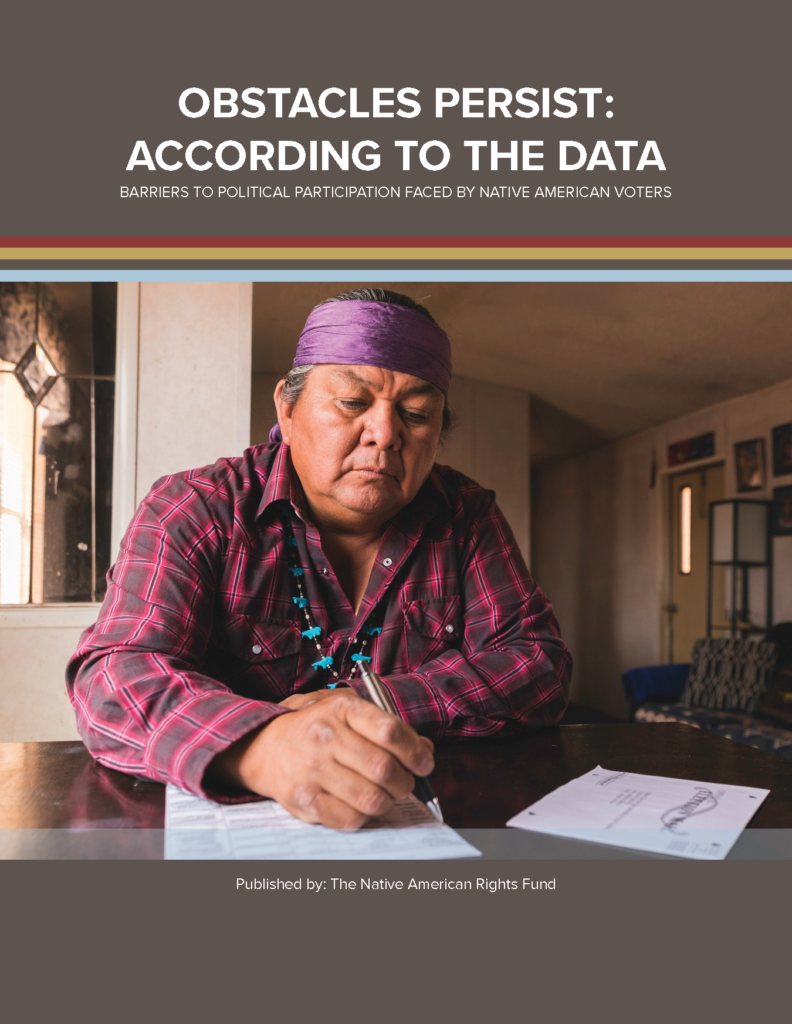
Native Americans continue to experience significant, compounding barriers to voting at every step of the election process, from registration to ballot counting, according to Obstacles Persist: According to the Data, a new report from the Native American Rights Fund (NARF) that analyzes data collected by the U.S. Election Assistance Commission from 2020, 2022, and 2024.
The numbers illustrate a voting process that is starkly different than what most Americans experience, resulting in higher rejections of voter registrations and ballots cast, and more voters removed from statewide rolls. This comes amid a raft of political efforts this year to restrict voting across the board. At the same time, the systematic dismantling of the Voting Rights Act has effectively removed the main tool voters have to challenge discriminatory practices.
“Voting is not a singular act, it’s a sequential process,” said NARF Senior Staff Attorney Allison Neswood. “It’s a chain of registration, voting, provisional votes, counting and curing ballots.”
Among the findings in the new Obstacles Persist: According to the Data report:
- Rejections of voter registration applications by mail and at DMVs skyrocketed in areas with larger Native populations, even as they fell nationally. Rejections rose by an average of 200% in counties where Native Americans are at least one-quarter of the population.
- The rejection rate of mail-in ballots rose in areas with larger Native populations, even as actual mail-in voting numbers declined. Between 2020 and ’24, rejections for missed deadlines increased 134% in counties where Native Americans make up more than 25% of the population, compared to a rise of 55% nationally, strong evidence that USPS network disruptions had a significant impact in Indian Country.
- While the rate of provisional ballots successfully counted in areas with larger Native populations rose between 2020-2024, it was still 15 percent lower than the national counted rate.
The causes for disparities in successful Native voting are sometimes familiar (such as short deadlines for receiving mail-in ballots), but often specific to Indian Country — such as voters being removed from rolls in areas where there is unreliable mail service, or poll workers not accepting tribal identification.
Obstacles Persist: According to the Data, follows Obstacles at Every Turn, which was released in 2020. The original report was based on testimony from 120 witnesses in nine public hearings held across the country. Obstacles Persist adds concrete statistical evidence to NARF’s ongoing investigations, based on recent election records.
“For Native Americans, the right to vote has been obstructed, delayed and denied across two centuries of United States history,” said NARF Senior Staff Attorney Jacqueline De León. “Closing that participation gap is not simply a technical problem. It’s a question of whether American democracy is willing to extend its guarantees to all its citizens, including the first peoples of this land.”
Read more about ongoing obstacles to Native voting at https://vote.narf.org/obstacles-at-every-turn/.
More blog posts