
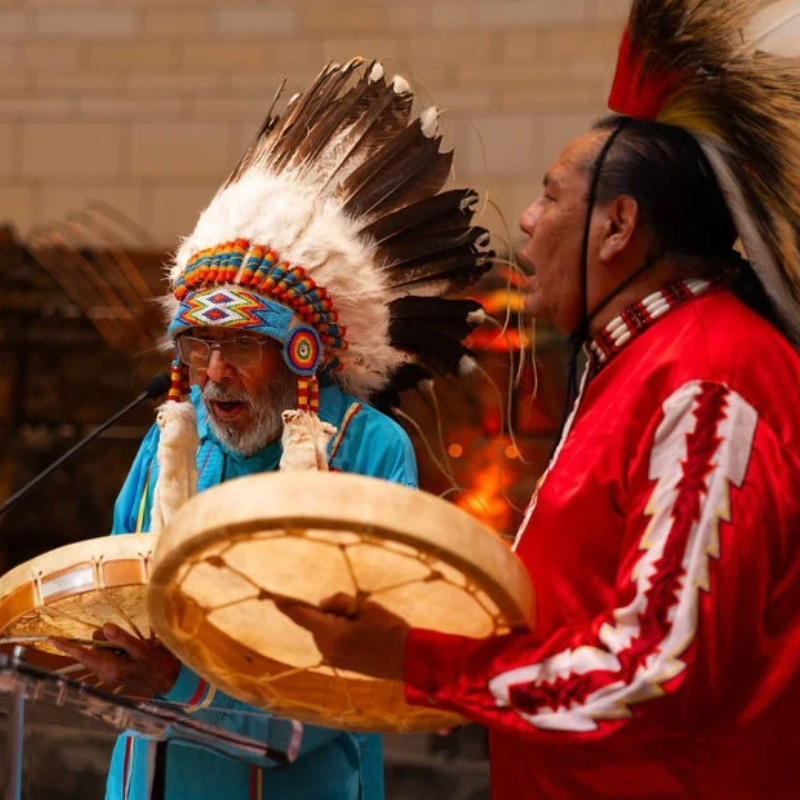
On September 17th and 18th, 2026, the Native American Rights Fund (NARF) and the National Congress of American Indians (NCAI), along with colleagues and friends, gathered in Washington, DC, to celebrate the 25th anniversary of the Tribal Supreme Court Project.
Formed in 2001, the Tribal Supreme Court Project is a partnership between NARF and NCAI that furthers the interests of Tribal Nations and Native American people in cases before the United States Supreme Court. The Project’s 25th anniversary was marked by an evening reception at the National Museum of the American Indian and a legal colloquium on Supreme Court Indian law jurisprudence and practice the following day.
“What’s been accomplished over twenty-five years is truly remarkable, “said Governor Stephen Lewis (Gila River Indian Community), during the reception’s opening remarks. “The project has helped Tribal Nations navigate some of the most important legal questions of our time.”
Key sponsors of the event included the Shakopee Mdewakanton Sioux Community, the Mashantucket Pequot Tribal Nation, and the Yuhaaviatam of San Manuel Nation among others. The Honorable Anne McKeig (White Earth Nation), Associate Justice, Minnesota Supreme Court, provided the reception’s keynote address.
Justice McKeig focused on the need to invest in developing Native American attorneys and the role the Tribal Supreme Court Project plays in elevating Native voices and practitioners. “I told myself it was okay that I did not have to be the same as my colleagues because I had a voice that was different but that was important,” she said. “Because if we don’t push ourselves out of our comfort zone and make ourselves have a seat at the table, we would not be where we are today.”
Other participants echoed McKeig’s call for investing in attorney development. “It would be important, and in Tribes’ interests, to get back to Native attorneys arguing before the United States Supreme Court and how can the Project help with that,” said NARF Staff Attorney Melody McCoy in a video presentation for the event. “If we can do that for Native attorneys, we can hopefully develop what many people are saying needs to happen, which is a Native Supreme Court practice bar,” said McCoy.
Speakers and presenters at the two days of events focused on recent victories for Tribal Nations in the Supreme Court including McGirt v Oklahoma (2020), and Haaland v Brackeen (2023). These cases illustrate the Project’s role in helping to advance Tribal sovereignty and shape legal doctrine by organizing comprehensive national advocacy efforts to support Tribal Nations’ cases.
“The threats to Indian Country are multiplying,” said NARF Staff Attorney Morgan Saunders in a video presentation for the event. “The need for increased intensity of legal strategy and briefing is only going to grow in the coming years. And so investment in what we do best is critical.”
This is one of those projects where it doesn’t matter what Tribe you’re from, what region you’re from,” said Rebecca Crooks-Stratton (Shakopee Mdewakanton Sioux Community) Chair, Board of Directors, Native American Rights Fund) in the video. “It’s something that we all understand the value of.”
The reception celebrated the work of the Project while the legal colloquium focused on the current state of Indian law and future priorities for the Project, including looking for ways to bring the Project’s expertise to lower courts, analyzing the Supreme Court’s Indian law jurisprudence, and deepening attorney support for appellate and Supreme Court practice. All of which reflected the priority initiatives found in the Project’s 25th Anniversary Report.
“Being together at the National Museum of the American Indian reminds us what this work is about — supporting Tribal Nations, Tribal sovereignty, and Native people,” said NARF Executive Director John Echohawk at the reception via a video address. “Despite our successes, the work is not finished. Tribal Nations continue to face difficult cases. Our job is to be ready, to stand together, and to make sure the Supreme Court hears from Indian Country with unity, clarity, and strength.”
Find out more about the Tribal Supreme Court Project here.