
By: Tom Murphy
June 8, 2026
Published as part of The Headwaters Report
This article provides a case review and discussion of a growing conflict between Tribal Nations and non‑Indian landowners over who has the authority to regulate water use on non-Indian fee land within reservation boundaries—Tribes or states. Tribal Nations have long‑recognized rights to the water needed to sustain their communities, and legal precedent supports Tribal regulation of activities within reservation boundaries that can negatively impact those water supplies. As demand for water resources increases, many Tribal Nations are finding it necessary to enact their own laws and ordinances to protect their water supplies, and this is leading to disputes with nonmembers over who has jurisdiction over water use.
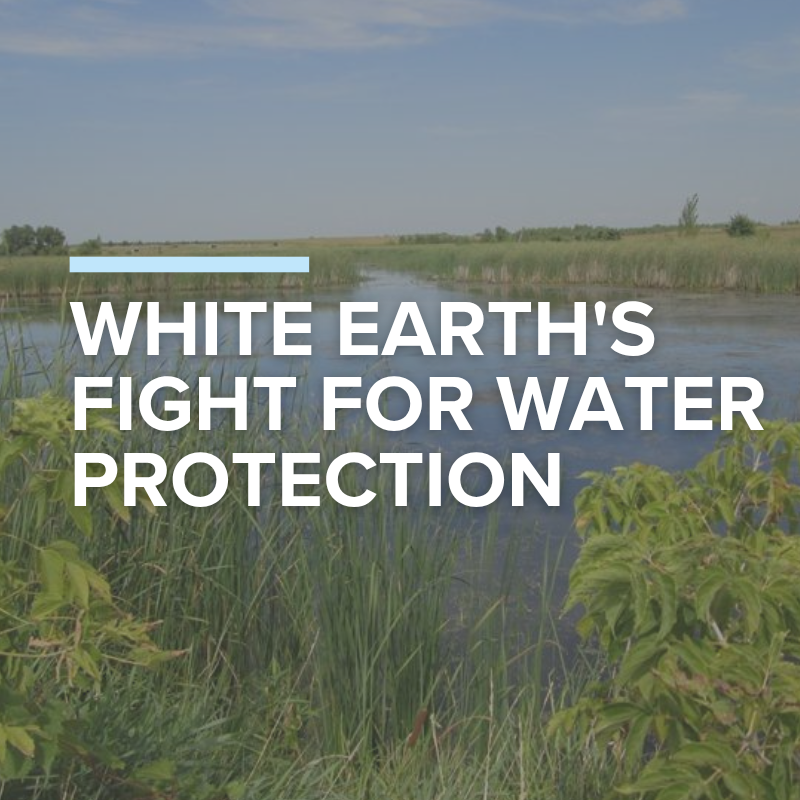
One such law, enacted by the White Earth Band of Chippewa Indians in Minnesota, led to a major legal dispute when a local non-Indian farmer, David Vipond, sought to pump large amounts of water from a culturally important river without following Tribal permitting rules. The Tribe took the issue to the White Earth Tribal Court, and Vipond tried to stop the case in federal court, arguing the Tribe had no authority over him. In Vipond v. DeGroat[1], the Eighth Circuit Court of Appeals ultimately ruled that Vipond must first go through the Tribal Court process before turning to federal courts.[2]
The Eighth Circuit’s decision highlights a larger issue: Tribal governments need to regulate activities that affect their water resources, but United States Supreme Court precedent makes it difficult for Tribes to assert authority over non‑Tribal members unless the harm is sufficiently impactful to Tribal community wellbeing or jurisdiction is agreed upon. Moreover, courts often look at specific, individual actions in this analysis; however, the more significant harm may come from collective or cumulative action, such as the effect of ten groundwater wells rather than one. In other words, a restrictive impacts analysis could hurt Tribal regulatory authority.
While the case involving White Earth Band is ongoing, it could help clarify how far Tribal Nations can go in protecting their water when nonmembers’ actions—especially in the aggregate—pose serious threats to Tribal Nations’ health, culture, and survival.
To understand the Vipond case, it is important to begin with the origins of the legal recognition of Indian water rights. In Winters v. United States 207 U.S. 564 (1908), the United States Supreme Court held that when the United States establishes a reservation for an Indian Tribe, sufficient water is reserved to fulfill the reservation’s purpose. This doctrine—generally known as the federal reserved water rights doctrine—ensures that Tribal Nations have water necessary to support their ongoing governmental and community needs, including water for traditional and cultural purposes, agriculture, domestic use, commercial use and to support treaty rights to fish, hunt, gather, and trap.
There are currently 575 federally recognized Indian Tribes in the United States. While all federally recognized Indian Tribes, and arguably some state-recognized Tribes, are entitled to federally reserved water rights, as of May 2026, only 39 Indian water rights settlements have been approved. For those keeping score, that’s 39 Indian water rights settlements since 1978, a period of over 45 years, or an average of less than one settlement per year. The alternative to settlement for a Tribe is litigating federally reserved water rights—typically in state courts under the federal McCarran Amendment—a process which can take decades and requires substantial resources.[3]
Tribal Nations have found their water resources seriously threatened in different ways. For Tribes relying on surface water diversions or instream flows from flowing rivers, their water may be threatened by excessive upstream diversions, surface water reduction due to groundwater pumping, overappropriation, and poor water quality. For Tribes using groundwater, water resources may be threatened by off-reservation pumping from the same aquifer or water source, pollution, or infrastructure problems. For Tribes in many geographic areas, drought and the effects of climate change threaten all water supplies.
If a Tribal Nation does not have a water settlement or adjudicated water rights—and most do not—how does it protect its unadjudicated, unquantified water rights? An increasing number of Tribes have adopted laws and ordinances to protect their water rights and regulate water use on their reservations. These regulatory efforts, however, are subject to limits on Tribal court civil jurisdiction, most notably the Supreme Court’s decision in Montana v. United States,[4] and decisions following Montana. This conflict – between the need for Tribal regulation of water resources and limitations on Tribal court jurisdiction – forms the underlying basis of the recent decision of the United States Court of Appeals for the Eighth Circuit in Vipond.
Background
In 2023, the White Earth Reservation Business Committee of the White Earth Band of Chippewa Indians (Band) enacted the White Earth Reservation Groundwater and Surface Water Protection Ordinance (WPO), regulating both ground and surface waters on the White Earth Reservation. In adopting the WPO, the Band found that:
[T]he White Earth Natural Resources Department working with relevant scientific and community experts has identified significant threats to the Band’s health and welfare, spiritual subsistence, water rights and other treaty rights and treaty-protected natural resources from the individual and cumulative operation of high-capacity wells and high-capacity surface water pumps on the White Earth Reservation[.][5]
The WPO creates and administers a permitting program for high-capacity groundwater and surface water appropriations. Specifically, the WPO applies to appropriations of more than 10,000 gallons of water per day, or more than 1 million gallons of water per year within the White Earth Reservation.
David Vipond is a non-Indian farmer in Manhomen County, Minnesota, who owns and farms land entirely within the boundaries of the White Earth Reservation. Vipond’s land is adjacent to the Wild Rice River, a river of cultural and traditional significance to the Band, including a central role in the Band’s growing and harvesting of manoomin (wild rice). On March 27, 2023, Vipond applied to the State of Minnesota for a surface water appropriation permit under Minnesota law to pump up to 65.2 million gallons of water per year from the Wild Rice River to irrigate fields on his lands (up to 1,000 gallons per minute). Despite the Band’s objection to the permit, the State of Minnesota issued the permit in August 2023, allowing Vipond to begin immediately pumping from the Wild Rice River within the White Earth Reservation.
After Vipond ignored repeated requests from the White Earth Division of Natural Resources (WEDNR) to comply with the WPO, the WEDNR filed a declaratory judgment action against Vipond in the White Earth Tribal Court in August 2023, seeking a declaration that Vipond could not install or operate a pump on the Wild Rice River without complying with the WPO, and that the WPO governs the extent of Vipond’s right to pump water from the Wild Rice River. The WEDNR also sought preliminary and permanent injunctive relief.
The White Earth Tribal Court granted WEDNR’s motion for injunctive relief and Vipond appealed to the White Earth Band of Ojibwe Court of Appeals arguing, in part, that the exercise of jurisdiction over him did not meet the requirements of Montana. The Court of Appeals construed the order as a temporary restraining order and remanded the case back to the White Earth Tribal Court to allow the parties an opportunity to present evidence and arguments on the jurisdiction issue. Following remand, the White Earth Tribal Court dissolved the temporary restraining order and the parties engaged in proceedings on Vipond’s jurisdictional challenge. Ultimately, the White Earth Tribal Court held a two-day hearing in 2025, in which the court received more than 140 exhibits and took live testimony from 12 witnesses. Following the hearing, the court issued a decision on October 14, 2025, which affirmed the Band’s regulatory jurisdiction but held that it lacked adjudicatory jurisdiction. That decision is presently on appeal to the White Earth Band of Ojibwe Court of Appeals.
Before that, however, in August 2024, while proceedings were pending in the White Earth Tribal Court, Vipond filed a lawsuit in the United States District Court for the District of Minnesota against the judge of the White Earth Tribal Court and the Director of the WEDNR, seeking to enjoin the proceedings in the White Earth Tribal Court on the basis that the Court lacked jurisdiction over Vipond under Montana. The federal district court denied Vipond’s motion for a preliminary injunction and he appealed to the Eight Circuit, which affirmed the district court.
The Eighth Circuit Opinion in Vipond
The Eighth Circuit affirmed the district court’s denial of Vipond’s motion for a preliminary injunction of the Tribal court proceedings because he failed to exhaust his Tribal court remedies. Vipond.[6] The Tribal exhaustion doctrine requires that federal courts not act in cases involving Tribal court jurisdiction until such time as a party in the Tribal court action exhausts their remedies, which usually means “an initial decision by the trial court and the completion of [tribal] appellate review.”[7]In practice, this means that a defendant must first raise the jurisdiction issue in a Tribe’s trial court and, if the decision is adverse, appeal the decision to the Tribe’s appellate court for a final decision before filing a federal court action to enjoin the Tribal court proceedings.
While defendants are generally required to exhaust Tribal court remedies before seeking review in federal court, there are exceptions to the doctrine, which Vipond raised in his appeal. “A party need not exhaust tribal adjudication where ‘it is plain’ the tribal courts lack jurisdiction such that tribal adjudication ‘would serve no purpose other than delay.’”[8] The federal district court rejected this argument, concluding that Tribal court exhaustion was necessary “because the parties advanced ‘equally developed arguments’ on the impact of Vipond’s pump on the Wild Rice River and reservation resources” and was not “frivolous or plainly contradictory to established law.”[9] Indeed, the district court acknowledged WEDNR’s argument—that the pump Vipond sought to install and operate on the Wild Rice River is “exactly the sort of nonmember activity that tribes may regulate” under Montana.[10]
Vipond raised three arguments in opposition to the district court’s finding that he was required to exhaust his remedies in the White Earth Tribal Court, all of which were rejected by the Eighth Circuit. First, he argued that the Tribal exhaustion rule does not apply to a party challenging Tribal jurisdiction under the Tribal sovereignty exception. The “Tribal sovereignty exception” is a shorthand description of the Supreme Court’s language in Montana which authorizes a Tribe to exercise jurisdiction over nonmembers “within its reservation . . . that threatens or has some direct effect on the political integrity, the economic security, or the health or welfare of the tribe.”[11] The Eight Circuit rejected this argument, noting that “there is no categorical exemption to the exhaustion rule for parties challenging tribal jurisdiction under the tribal sovereignty exception.”[12]
Second, Vipond argued that the Tribal sovereignty exception does not allow Tribal regulation of a nonmember’s conduct on fee land they own within a reservation. While the federal district court did not believe this argument presented a “very close call,” in favor of Tribal court jurisdiction, the Eighth Circuit disagreed, but nonetheless agreed that exhaustion should be required. Relying on the Supreme Court’s decision in Plains Commerce Bank v. Long Family Land & Cattle Company, the court first noted that “efforts by a tribe to regulate nonmembers . . . are presumptively invalid.”[13] Further, the Tribal sovereignty exception applies only to conduct which “imperils the subsistence” of the Tribal community and “tribal power must be necessary to avert catastrophic consequences.”[14]
The Eighth Circuit, looking at Vipond’s conduct in isolation, focused on the impact one pump would have on White Earth Reservation resources:
Although the parties dispute the potential effect of Vipond’s pump on reservation resources, the Nation does not contest that Vipond’s planned appropriation of 65.2 million gallons of water annually would amount to roughly two percent of the volume extracted each year by wells and pumps already operating on the reservation. It is implausible that the marginal effect of Vipond’s extraction could so devastate the Nation’s resources as to “imperil [its] subsistence” or constitute a “catastroph[e].”[15]
However, while speculating that Vipond’s pumping, standing alone, would have little effect on Reservation resources, the court next acknowledged that United States v. Cooley, 593 U.S. 345 (2021) left open the possibility that the Tribal sovereignty exception “confers tribal jurisdiction over nonmembers engaged in on-reservation conduct that, in the aggregate, poses ‘catastrophic’ threats.”[16] The Eighth Circuit concluded:
the [Tribal] Nation has advanced a non-frivolous case that the increased extraction of water by new high-capacity pumps on the reservation will deplete resources that are vital to the Nation’s health and welfare. Therefore, the law does not clearly establish that the Nation’s assertion of authority over Vipond in these circumstances is so “frivolous or obviously invalid under established law” as to exempt him from the Tribal exhaustion rule.[17]
Third, Vipond argued that Tribal exhaustion was unnecessary because WEDNR should have joined the State of Minnesota in its lawsuit. The Eighth Circuit summarily dispensed with this argument on the basis that whether Minnesota is an indispensable party “has no bearing on the necessity of exhaustion.”[18]
The Eighth Circuit affirmed the federal district court’s judgment, which stayed the federal case pending the completion of the Tribal adjudication. As of the date of this article, the case is pending on appeal at the White Earth Court of Appeals.
The Case for Tribal Jurisdiction over On-Reservation Waters
While an initially favorable decision for the Band, Vipond points to a major problem with how some courts have interpreted United States Supreme Court jurisprudence on Tribal court civil jurisdiction. Under the narrow reading of the Supreme Court’s Montana/Plains Commerce approach in dicta in Vipond, a Tribal court lacks jurisdiction over a nonmember unless it can prove that the nonmember’s specific conduct, in general terms, imperils the subsistence or welfare of the Tribal community.[19] Thus, viewing Vipond’s proposed appropriation of water in isolation, the Eighth Circuit reasoned that the “marginal effect” of the pumping would not imperil the Band’s subsistence or constitute a catastrophe.[20] However, individual conduct is often not the reality Tribes face, particularly when it comes to natural resources.
Substantial authority supports an approach to Tribal court jurisdiction and regulatory authority which looks at a “class of conduct” rather than the individual. Montana, for example, looked at all non-Indian hunting and fishing and not on a “hunter-by-hunter” basis. Likewise, in Cooley, the Supreme Court, applying Montana, held that Tribes retained the authority to temporarily detain and search non-Indians traveling on public roadways through Indian reservations. Tribal Nations are “‘distinct, independent political communities’ exercising sovereign authority.”[21] Tribal Nations’ inherent sovereign authority includes the power to exercise civil adjudicatory and regulatory jurisdiction over non-Indians and their activities and conduct.[22] This is the approach courts should take in matters involving Tribal regulation of water resources.
When considering adopting water protection regulations, the Band determined that the impacts of groundwater pumping and surface water diversions on or near the White Earth Reservation, in the aggregate or cumulatively, pose a threat to the White Earth Nation and, in an exercise of its inherent sovereign authority, adopted the WPO. The resolution adopting the WPO recognized, quoting Montana, that the Band “retain[s] inherent power to exercise civil authority over the conduct of non-Indians on fee lands within its reservation when that conduct threatens or has some direct effect on the political integrity, the economic security, or the health or welfare of the tribe.”[23] And, while not adjudicated or quantified, the Band has federally reserved water rights sufficient to fulfill the purposes of the White Earth Reservation, as stated in Winters, and to support any reservations of rights in the Band’s treaties with the United States under Winans v. United States, 198 U.S. 371 (1905).
As the Ninth Circuit has observed, “‘threats to water rights may invoke inherent tribal authority over non-Indians’ due to the tangible and direct impact that such threats pose to tribal health and welfare.”[24] This presumption that Tribes have regulatory authority over water within their reservations based on the importance of water to Tribal communities, makes sense.
Further connecting water’s role to Tribal welfare, the Ninth Circuit concluded “[r]egulation of water on a reservation is critical to the lifestyle of its residents and the development of its resources. Especially in arid and semi-arid regions of the West, water is the lifeblood of the community. Its regulation is an important sovereign power.”[25] In Walton, the court held that the State of Washington was preempted from permitting water uses on the Colville Reservation.[26] Citing Montana, the Ninth Circuit held that Colville’s exercise of regulatory jurisdiction over a non-Indian’s water use on-reservation fell within Montana’s second exception:
A tribe retains the inherent power to exercise civil authority over the conduct of non-Indians on fee lands within its reservation when that conduct threatens or has some direct effect on the health and welfare of the tribe. This includes conduct that involves the tribe’s water rights.[27]
In Montana, the Supreme Court added a footnote to its articulation of the Tribal sovereignty exception: “As a corollary, this Court has held that Indian tribes retain rights to river waters necessary to make their reservations livable.”[28] The Montana Court cited to a specific portion of Arizona v. California that leaves little doubt it considered the protection of Tribal water resources to be fundamental to survival. Writing for the majority in Arizona, Justice Black quoted the delegate from the Territory of Arizona in debate leading up to the approval of the first appropriation for the irrigation of the Colorado River Indian Reservation:
Without water, there can be no production, no life; and all they ask of you is to give them a few agricultural implements to enable them to dig an irrigating canal by which their lands may be watered and their fields irrigated, to that they may enjoy the means of existence.[29]
The Supreme Court’s general recognition of threats to Tribal subsistence as a basis for the exercise of Tribal jurisdiction is grounded, in part, on its prior recognition of Tribal water rights. Together, these pronouncements reflect an understanding of water’s profound importance to Tribal Nations, both as a legally protected property right and as fundamental to healthy Tribal communities, each necessary to the exercise of Tribal sovereignty.
Allowing nonmembers to avoid Tribal court jurisdiction by analyzing their conduct in isolation essentially allows the exception to swallow the rule. Many Tribal Nations that have adopted laws and ordinances to regulate various types of conduct have done so because of the conduct of nonmembers within their reservation boundaries. The Vipond federal court proceedings are currently stayed while proceedings take place in the White Earth Band of Ojibwe Tribal Court of Appeals. However, there is a chance it will return to the Eighth Circuit following a final decision. If it does, the federal courts may have to squarely address the issue of civil jurisdiction over nonmembers for conduct that is regulated by a regulatory scheme necessary for the protection of Tribal water resources.
[1] 166 F.4th 694 (8th Cir. 2026)
[2] Id. at 702.
[3] [3] A good example is the adjudication in United States v. Walker River Irr. Dist., No. C-0127 (D. Nev.), where after nearly 100 years of litigation, in November 2024, the federal district court entered an order approving a stipulation among the parties that quantified and prioritized the water rights claims of the Walker River Paiute Tribe.
[4] 450 U.S. 544 (1981)
[5] Resolution No. 057-23-017 (May 5, 2023).
[6] 694 F.4th at 699.
[7] DISH Network Serv. LLC v. Laducer, 725 F.3d 877, 882 (8th Cir. 2013) (citing Iowa Mut. Ins. Co. v. LaPlante, 480 U.S. 9, 17 (1987).
[8] Vipond, 166 F.4th at 699.
[9] Id.
[10] Vipond, 166 F.4th at 699.
[11] Montana, 450 U.S. at 565-66.
[12] Vipond, 166 F.4th at 700.
[13] 554 U.S. 316, 330 (2008).
[14] Vipond, 166 F.4th at 700 (quoting Plains Commerce, 554 U.S. at 341)
[15] 166 F.4th at 700-701.
[16] Id. at 701.
[17] Id. at 701-702.
[18] Id. at 702.
[19] Montana “authorizes the tribe to exercise civil jurisdiction when non-Indians’ “conduct” menaces the “political integrity, the economic security, or the health or welfare of the tribe.” 450 U.S. at 566. “The conduct must do more than injure the tribe, it must “imperil the subsistence” of the tribal community.” Plains Commerce, 554 U.S. at 341.
[20] Vipond, 166 F.4th at 701 (citations omitted).
[21] Cooley, 593 U.S. at 349 (quoting Worcester v. Georgia, 31 U.S. 515, 559 (1832)).
[22] Iowa Mut. Ins. Co. v. LaPlante, 480 U.S. 9, 18 (1987).
[23] 450 U.S. at 565-566.
[24] Bugenig v. Hoopa Valley Tribe, 229 F.3d 1210, 1222 (9th Cir. 2000), vac’d on other grounds 266 F.3d 1201 (9th Cir. 2001) (en banc) (quoting U.S. Envtl. Prot. Agency v. Montana, 137 F.3d 1135, 1141 (9th Cir. 1998) (“U.S. EPA”)).
[25] Colville Confederated Tribes v. Walton, 647 F.2d 42, 52 (9th Cir. 1981); c.f. Albuquerque v. Browner, 97 F.3d 415, 423 (10th Cir. 1996).
[26] 647 F.2d at 51 (citations omitted).
[27] Id. at 52 (citations omitted).
[28] 450 U.S. at 566 n.15 (citing Arizona v. California, 373 U.S. 546, 599 (1963)).
[29] Id.
More blog posts